
The NBCI Launches Historical National Clinical Trials Strategic Plan (NCTSP) Through 150,000 Black Churches
The National Black Church Initiative (NBCI) (https://naltblackchurch.com), a coalition of 150,000 African American and Latino churches, has established a program to help close that gap. NBCI, representing 27.7 million members, is dedicated to eliminating racial disparities in healthcare, technology, education, housing, and the environment.
This program is in keeping with NBCI National Black Health Agenda (https://naltblackchurch.com/pdf/blackhealthagenda-congress.pdf). This report was sent to Congress, spelling out the needs of African Americans before the 2024 election. The report is our bellwether on Black health. Through the NBCI, the Black church has developed the most comprehensive program to educate, empower, recruit, and sustain maximum participation of African Americans—along with African American physicians—in clinical trials. This
initiative, known as the American Clinical Health Disparities Commission (ACHDC) (https://achdc.net/), marks the first serious and holistic effort to build on past attempts that failed to engage the Black community effectively.
Given the ongoing healthcare crisis affecting African Americans, which has worsened over the
past 400 years, as highlighted by NBCI in its 2024 report to the U.S. Congress, “Moving Toward a National Health Agenda”, this initiative demands full support from both industry and government.
National studies consistently show that the Black church’s faith-based, science-driven approach has the most potential for success, owing to its deep-rooted position within the Black community.
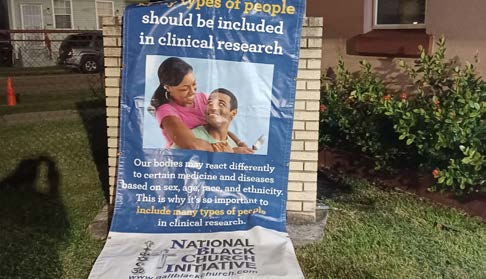
NBCI’s mission is to deliver essential wellness information to its members, congregants,
churches, and the broader public. NBCI employs innovative and impactful solutions to address
persistent economic and social challenges by combining faith with evidence-based health
science. The organization seeks partnerships with key entities and officials committed to reducing racial inequalities in these critical areas. NBCI’s programs are driven by credible data, scientifically supported strategies, and proven methods that produce measurable results.
With the help of health experts, NBCI has developed a seven-part approach for improving Black health, and a major one encourages participation in clinical trials. This approach
educates on trials and the conditions that greatly impact Black and Latino communities. That
education also includes evidence-based insight on preventing and managing certain conditions.
With that in mind, NBCI is trying to solve a decades-old problem. Why do African Americans
refuse to participate in clinical trials?
The complicated and yet straightforward answer is the fraught relationship between the US
healthcare system and the strides made at the detriment of people of color.
That is where the Black church comes in. The creation of the blackchurchclinicaltrials.com
(https://blackchurchclinicaltrials.com/) website is an innovative and interactive tool that, alongside the seven-clinical approach, is exactly what is needed in the Black church toolkit to provide its 27.7 million members with the critical information necessary to make informed decisions about participating in clinical trials.
One example of the website’s content is the NBCI Clinical Trials Education Awareness Interactive Booklet, which helps members understand the risks and benefits of clinical trials. This booklet is specifically designed for African Americans by African American educators who are familiar with their various learning styles and approaches, as outlined by the NBCI Literature Review Committee.
Historic Mistreatment
The most famous case of mistreatment is the Tuskegee syphilis study, which stripped Black men of informed consent and available treatment options. The mistreatment did not stop there, and from the 1950s to 1970’s predominantly Black prisoners were experiment subjects for a renowned
dermatologist who discovered tretinoin. Even centuries before, the country’s earliest medical
advances were achieved at the expense of enslaved people. For instance, J. Marion Sims, who has been dubbed the “father of gynecology,” performed vaginal fistula surgeries on enslaved women without the use of anesthesia. Further, the controversial treatment also extends to Native Americans and Latinos. In the 1970’s, up to 42% of native women of childbearing age were sterilized. Also, in the 1950s, up to 1/3 of child-bearing-aged Puerto Rican women were sterilized and unknowingly used as test subjects for the development of modern birth control.
Fortunately, in modern times and with better government oversight, clinical trials have been crucial for developing weight loss drugs, treating various cancers, and in late 2023, finally developing an effective treatment for sickle cell anemia.
Treating many conditions is important for diverse representation, since some groups may face worse outcomes or have a complex presentation of the disease. Diversity helps to uncover social determinants of health,including barriers to treating and complying with care. Nonetheless, the distrust in clinical trials persists. Treating many conditions is important for diverse representation, since some groups may face worse outcomes or have a complex presentation of the disease. Diversity helps to uncover social determinants of health, including barriers to treating and complying with care. Nonetheless, the distrust in clinical trials persists.
The Role of the Black Church
The Black church has been a refuge for its community and has built trust with Black people through commonality and shared customs. NBCI comprises 150,000 Black and Latino churches with 27.7 million members.
The Black church has the duty of facilitating meaningful conversations around faith and starting conversations around the community’s overall wellbeing. That’s why Black churches
have been effective in combating issues such as COVID-19 vaccine hesitancy. NBCI has also successfully distributed information to and educated over 50,000 congregants who might not otherwise participate in clinical trials.
Considering its impact, NBCI has taken on a more significant task of fighting for health equity through trial access. This is NBCI’s solution: NBCI National Clinical Trial Strategic Plan (NCTSP). The NCTSP aims to promote an interdisciplinary collaboration involving the pharmaceutical industry, government, and public health organizations to boost African American enrollment in clinical trials significantly. Additionally, the goal is to strengthen the roles of both NCTSP and ACHDC as trusted and effective partners while enhancing African Americans’
awareness and understanding of clinical research. This education can help to eliminate unethical practices through informed consent.
The NCTSP fits within the recommendations of NBCI and the American Clinical Health Disparities
Commission (ACHDC), a task force comprising 42 African American physicians. The ACHDC’s objective is to oversee the strategic plan, lending guidance, technical support, ethical clinical trial protocols, and standards for critical data collection, education, literature, video development, program management, and safety.
The seven-part approach, as outlined in the plan includes the following:
1. Health education
2. Disease prevention and health promotion
3. Establishing best practices for disease management
4. Explaining risks and benefits to
encourage clinical trial participation
5. Critical data collection
6. Providing church members with access to
care
7. Publication of scientific findings
Health Education
NBCI is educating the church through various modes of communication. The website currently offers modules and other online tools for congregants. NBCI even provides a glossary of common medical words that prospective participants may not understand. The website also maintains a database of up-to-date trials sorted by condition and the first-of-its-kind course on clinical
trials.
To go even further, NBCI has plans to distribute a newsletter called CLINICALNEWS. It will be a single-sheet news briefing to inform low-income Black and Latino communities about clinical trials. It will provide essential information on the basics of clinical trials, including their benefits and risks, in simple language. This news brief will be distributed to 150,000 churches nationwide and shared through human and civil rights organizations. Additionally, it will be published on social media, included as a supplement in 274 Black newspapers, and shared with regional dailies targeting African-American and Latino communities.
Increasing education leads to more informed consent, which can boost confidence in those considering the risks and benefits of participating in clinical trials.
Disease Prevention and Health Promotion
These practices should be carried out with insight from health professionals and government
agencies. That is why NBCI collaborates with the ACHDC to disseminate accurate health information, which is shared through various channels, reaching congregants in whatever way best serves them. Along with this step is establishing best practices for disease management, which is evidence-based and also overseen by physicians and qualified health professionals.
NBCI will also appoint a Black and Latino surgeon general. The purpose of the Surgeon General is to serve as the Chief Medical Officer for both the Black and Latino church and the broader
communities, supported by 37 major Protestant denominations. These individuals will address
health priorities and strategies tailored to high-disease states within the community.
Additionally, they will act as a spokesperson for the community, engaging with the White House, federal agencies, pharmaceutical companies, and Congress, to help shape fair and unbiased health policies for African-Americans.
Explaining Risks and Benefits to Encourage Clinical Trial Participation
Trust is missing in Black people and the healthcare industry. To build trust between researchers and study participants, transparency will be necessary. That is why trials are vetted for their potential risks and benefits before they become a part of the database. If information is not provided in a way that congregants can understand, they can not
consent.
Critical Data Collection
NBCI keeps an extensive database of clinical trials related to 11 chronic health conditions prevalent in the Black and Latino communities. Data collection is just as important as providing information on various conditions readily available for church members to explore their care options, and to discover best practices for treating their conditions, with social determinants of health taken into consideration. Through the databases and resources provided, vulnerable community members may find more straightforward access to care.
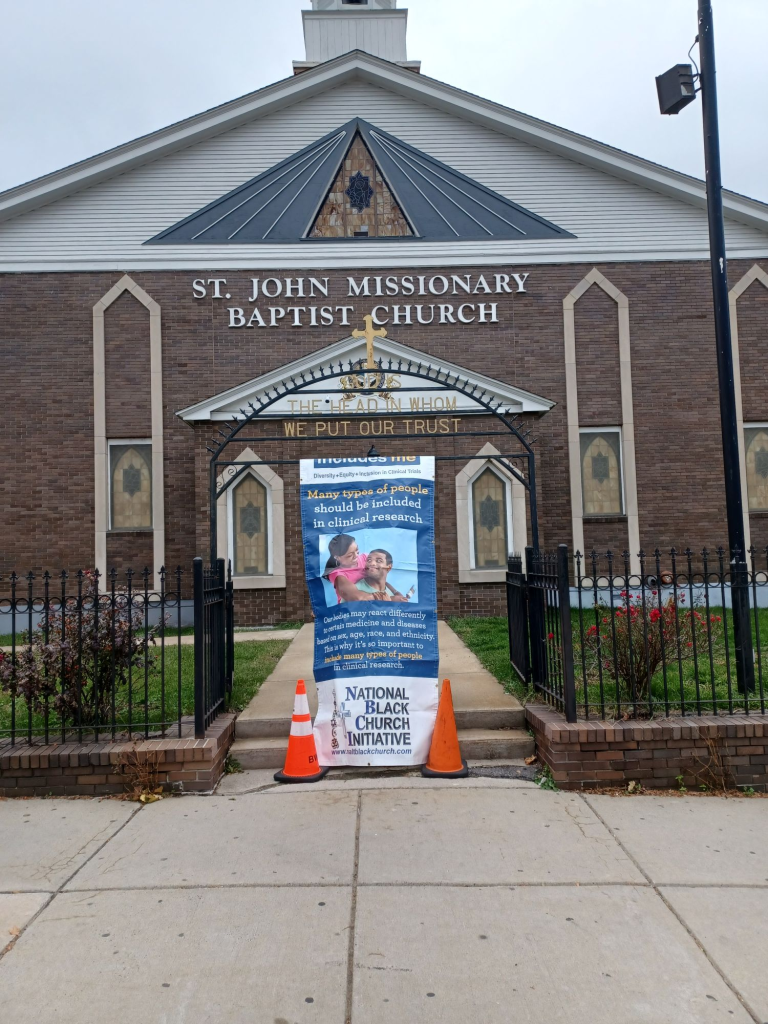
These seven approaches bolster the measures already taken by NBCI to ensure health equity. In
2017, the organization submitted a recommendation to the FDA for navigating the lack of participation in trials and at the height of COVID, distributed over 3.5 million first and second editions of Vaccnews to congregants.
While the NBCI has made great strides to help close the healthcare gap, their long term goal is to facilitate record participation in trials. Moving forward, that will take buy-in from the NIH, FDA, and pharmaceutical companies that recruit and carry out trials. Within the next five years, with the help of government and private entities, they hope to educate 150,000 to 300,000 people.
AND LATINO COMMUNITIES: NBC I CLINICAL RESEARCH APPROACH
There are thirteen (13) pillars of NBCI Clinical Research Approaches to be used:
- Cardiovascular Diseases/Stroke and
- Hypertension Blood pressure
- Cancer (Liver/ Kidney/ Lung)
- Diabetes
- Blood Diseases
- Genetic Disease ( Sickle Cell)
- Mental health
- Access to Care/ lifestyles/ Selfcare
- Parkinson Disease
- Rare Disease
- Alzheimer’s Disease
- Kidney Disease
- Collection of Health Data
The NBCI Launches Historical National Clinical Trials Strategic Plan (NCTSP) Through 150,000 Black Churches
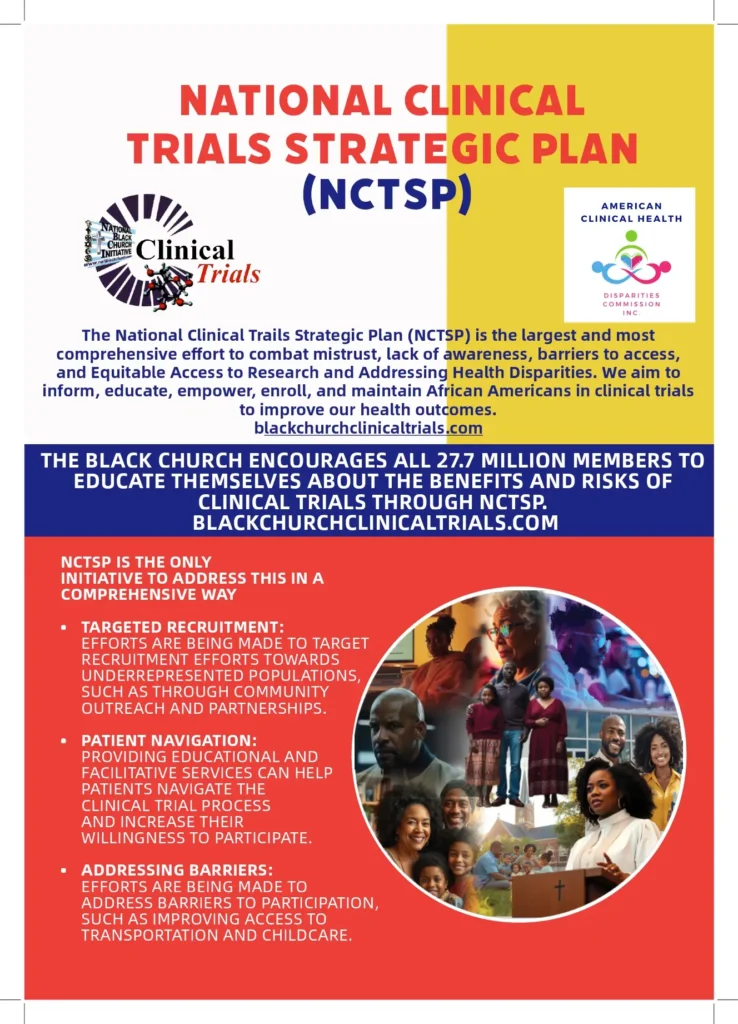
The National Black Church Initiative (NBCI), a coalition of 150,000 African American churches and 27.7 million members, launches the National Clinical Trials Strategic Plan (NCTSP) to inform, empower, educate, enroll, and maintain African Americans in Clinical trials.
This will prove to be one of the most significant efforts to improve health in the African American community. This is truly a historical moment for the Black churches as they seek to build and sustain an interdisciplinary approach.
Download a copy of the NCTSP brochure today at
https://naltblackchurch.com/health/pdf/ntcsp-booklet-
v4.pdf